
Deny Yourself
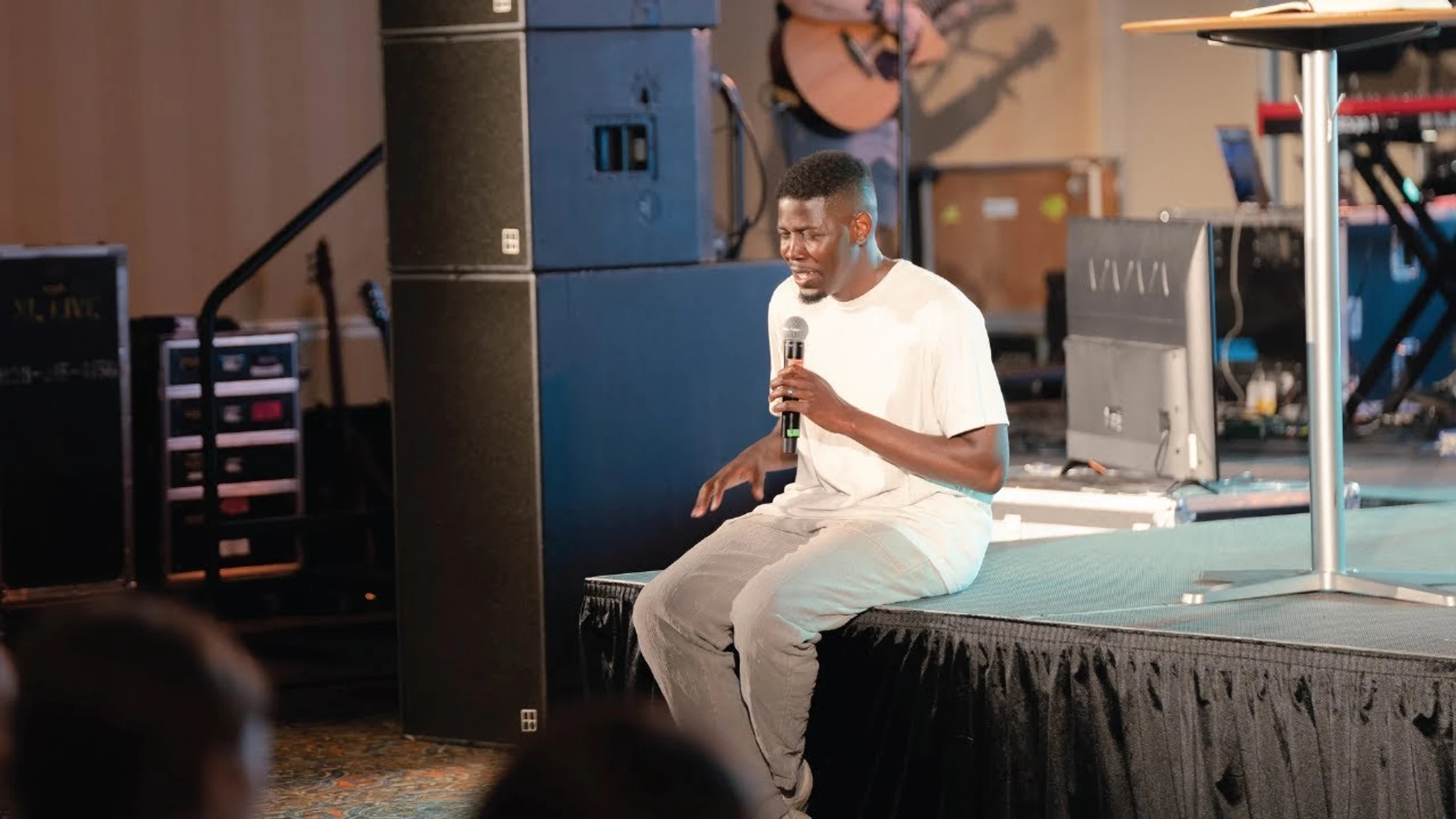
Movement. Come on. I am so excited and stirred to be with you guys tonight in this week. And I really do believe that the Lord is going to meet each of us in such a special and unique way. How many of you guys are believing for that?
Come on. This week? Come on.
Yeah. Jesus, we love you and we thank you for your presence, your presence in this place.
You are here.
And we ask, Lord, that you would sharpen our senses to discern you and to see you.
Jesus, we just don't want to. Just to gather, just to sing songs and hear a message, but we want to encounter you, the living word. So, Jesus, we ask for whatever you have to do, whatever you have to move out of the way so that we can meet you in this space tonight. We ask, Lord, that you do it, that we give you permission. We give you permission, Lord, and we just open ourselves up tonight as an altar a availability and we just say, lord, come and have your way.
Do what only you can do. Not anything that we can conjure up in our own strength. But we ask for your living presence to meet us, to meet us, to meet us tonight.
So maybe in your own way, if you can close your eyes and just begin to ask the Lord in your own words, would you just surprise me this week? Would you just allow me to leave this place different? Allow me to leave this place not the same way that I came here. I will leave this place looking more like you, that I'll leave this place more in love with you, that I will leave this place more free than I am right now.
Whatever weight or bondage that I came into this space this weekend with. Lord, would you meet me in my brokenness? Will you meet me in my mess? Will you meet me in my sin?
We say, living God, do what only you can do in our hearts tonight. In Jesus name, Amen. Amen. Awesome. Well, again, I'm so stirred and excited to be here.
And my name is Nico Peel and I work with the ministry calling Night Movement. And we minister on college campuses and cities across the East Coast. And I can just tell you that as we're ministering among the next generation, that there is a hunger for God, that there is a desperation for God. And I remember being in middle school and high school and I remember being gripped with God's heart for revival and awakening. I was watching Christian television and there was like some crazy Pentecostal stuff going on.
I'm like, what is that? What is that? And as I began to just press into the heart of God, he began to grip my heart with this idea of revival. I had no idea what revival was. Revival in my context was like a three night prayer meeting that we did in the spring, in the summer, growing up at church.
But the Lord began to grip my heart with was this burning desire for more. I knew what I was living for and what I was doing was not, it was not meeting or satisfying the longings and desires of my heart. It was a longing for more. And the Lord began to grip my heart to contend for something more. And I'm here tonight to tell you that there is more for you.
There is more for you. This is the truth. That we are the sanctuaries that God desires to fill, that you are the altar that he is longing for, that you are the object of his affection and his love. Tonight I want to talk about our reason for existence. We're going to be going through several passages tonight, but the first passage is Acts 17.
In Acts 17:26, the apostle Paul shares about the providential grace of God as it relates to our predetermined times and place of existence. In his Gospel presentation to some Athens Greek idol worship, he says this verse 26 from one man he made all the nations that they should inhabit the whole earth. And he marked out their appointed times in history and their boundary lines. What this means for us is that the family that you were born into, the town and city that you live in, the period in time and the history that we all find ourselves this very moment did not happen through happenstance or coincidence, but in fact it's the quite opposite. It has been divinely orchestrated and providentially orchestrated by God, not void of purpose and intent.
And Paul goes on to say that God has selected both our time of existence and the boundary lines in which we live for this main purpose, so that we will seek him, and that in our seeking him, that we will find him, and in our finding him that we will become like Him.
This statement answers some of the deepest questions of the human soul. Paul is saying that we were not just born for such a time as this, this era, in this generation, in the cultural moment that we live in, but all the way down to the point of where we live, in the family that we are part of, in the schools and the groups that we belong to, has been divinely orchestrated by God, all for the primary and ultimate purpose to seek God, and that in our seeking that we will behold him, and that in our beholding we will become like Him. The Westminster Catechism asks this question. What is the chief end of men? Man's chief end is to glorify God and to enjoy him forever.
The question that at some point in our lives that we all ask is, why do I exist? What was I made for? What is my destiny? We live in a cultural narrative that tells us that we can choose and define our own identity and create our own destiny, that we can manifest our future through positive thinking and mindfulness. These cosmos cultural narratives are constantly tugging at the core longing of humanity, the longing for identity and acceptance and purpose and joy.
These are the things that we find ourselves consumed by. And in reality, they're thrusting us into a vortex of comparison and striving and performance and leaving us, this generation, lonely and depressed and empty. Here, Paul tells the Athens idol worshipers, he says, this is not what you were made for. This is not the purpose of your existence, that you were not made just to chase the Roman dream. You were made for something more than the cultural narrative of.
Of your time, that you were made for something greater than the metrics of Roman success, that you were made to know the true and living God and to make him known. And in this relationship, that we are giving real identity, that we are giving real purpose, and that we are given real joy. And no matter how hard we try, we cannot have these things truly apart from God. This truth that Paul is preaching is. It was true then, and it's true for every single one of us in this room, and it's true for every single living and breathing human being that exists.
That we were made and we were created for God. That we were made and created to seek and to behold God.
This message that Paul would deliver to the people of Athens, A place that was considered the greatest city inside of the greatest nation of the world. It was known for its worship of idols and gods.
There was an idol in God for nearly everything that you can imagine. Athens was known as the junkyard of idol. Over 30,000 idols. And as Paul walked through this city, his heart became filled with pain, with distress and sorrow.
With a natural eye, you could see all the beautiful statues and temples and altars. But Paul was able to see beyond that. Paul was able to see beyond the fancy sculptures and idols and what he saw. He saw vain pursuit.
He saw the things that a generation deemed important and significant in their own eyes.
The idols mirrored the things that they were passionately pursuing and was giving themselves over to.
But of the many idols and altars, there was one in particular that caught Paul's attention. It was this altar. And on this altar, it was inscribed to an unknown God. Now this was interesting to Paul because if the other, the other idols were a window into the center of people's heart, this altar was a confession of the deep void and gap in a generation's soul, a longing and a yearning for more, a void that the 300,000 other idols could not feel. And all of their faithful worship to their false gods, there was still something inside of them that was missing.
There was still something that they were reaching for. There was still something.
And Paul uses this moment to redirect their gaze, to redirect their gaze from vain pursuit to a person, to a person who blood closed the gap between our deep longing and ultimate satisfaction.
He invited them to shift their gaze to a perfect lamb who willingly offers himself to take away the sins of the world. He says, hey, you've been beholding these idols, these pursuits in which you have become your idols. He says, but I'm going to give you something more beautiful to look at. I'm going to give you something that's going to bring true transformation and satisfaction to your soul, that's going to reach into the deepest longings and desires.
So Paul begins to proclaim the good news of Jesus and his crucifixion. Paul begins to confront the idols in their hearts.
He says, you think you were born in this moment in time and brought into this particular place to chase the Roman dream of success and earthly pleasures, pleasures and pursuits that you have made your gods. He says, but I have good news for you. You were born for such a time as this, in this particular place to seek the one and true living God. This God is the creator of heaven and earth, the one who does not dwell in temples shaped and carved, the hands of man like your idols and altars and temples. The God who is the source of life and of all nation, the God who predetermined your time of existence and the boundary lines in which you will live.
The one who you are unwillingly seeking, the one that you yet do not know. But I have good news that this unknown God, not far away, but he is near. In fact, it is him that we live and move and have our being. He is the reason for your existence. You have made gods out of your pursuits, but yet you still feel empty.
But do you not know that the gods you have created, they have mouths, but they do not speak. They have eyes, but they do not see. They have ears, but they do not hear, nor is there breath in their mouths. The gods that you serve are dumb, but the true God that your soul longs for is all Knowing all powerful. His eyes is like a flame of fire that's filled with zeal and passion and jealous love for you that just doesn't see the surface.
But he sees the depths into your soul. His ears not only hear our voices when we cry out to him, but it hears the whispers and the cries and the shouts of our hearts. His voice is like the sound of waters, of many waters. And when he speaks, it shatters the darkness. It shuts the mouth of the accuser.
It causes anxiety and depression to topple on his face. This is the God who you are seeking. And he can be found. The face of Jesus. Our main text for the night is John 1, verse 19.
We'll read through the 37th verse.
And this is the testimony of John. When the Jews sent priests and Levites from Jerusalem to ask him, who. Who are you? He confessed and did not deny, but confessed, I am not the Christ. And they asked him, what then are you, Elijah?
He said, I am not. Are you the prophet? And he answered, no. So they said to him, who are you? We need to give an answer to those who sent us.
What do you say about yourself? He said, I am the voice of the one crying out in the wilderness, make straight the way of the Lord. As the prophet Isaiah said. Now they had been sent from the Pharisees. They asked him, then why are you baptizing if you are neither the Christ nor Elijah, nor the prophets?
John answered them, I baptized with water. But among stands one you do not know. Even he who comes after me. The straps of his. Of his sandals I am not worthy to untie.
These things took place in Bethany, across the Jordan, where John was baptizing. Verse 29. The next day he saw Jesus coming towards him. And he said, behold the Lamb of God who takes away the sins of the world. This is he of whom I said, after.
He comes a man who ranks before me because he was before me. I myself did not know him. But for this purpose I came baptizing with water that he might be revealed to Israel. And John bore witness. I saw the Spirit descend from heaven like a dove, and it remained on him.
I myself did not know him. But he who sent me to baptize with water said to me, he on whom you see the Spirit descend and remain. This is he who baptized with the Holy Spirit. And I have seen and I borne witness that this is the Son of God. The next day again, John was standing with two of his disciples.
And he looked at Jesus, and as he walked by him and said, behold the Lamb of God. The two disciples heard him say this and they followed Jesus.
This is the truth that we serve a jealous God that he is jealously in love with, with each of you in this room tonight. And his jealous love is like a consuming fire. And I believe that the answer to the spiritual crisis and dilemma of our time and of our day is found in beholding the face of Jesus. Whether it is the Athens, the message that Paul gave to the Athens idol worshipers, or whether it's the message that John gave to the Pharisees and to the Israelites that the answer to the spiritual dilemma in the crisis that we live is the face of Jesus. And he calls a generation to behold the Lamb who takes away the sins of the world.
And I believe that this week that God wants to make this place an altar for encounter wherever idol, whatever sin, whatever that we're bringing into this room tonight. The known, the unknown, the things that we're watching that no one sees whenever, when no one is around, the jokes that we laugh through, the little thoughts that we entertain in our minds. I believe that Jesus is inviting us to lay those things at his feet tonight, this week. And even as I was praying for this gathering, I just felt from the Lord that not only there's a divine invitation to come and to lay these things at the altar, but I believe there's also a divine confrontation. There's something that sometimes that God shows up so uniquely that in his presence, idols, sin cannot stand, but yet they topple on their face.
And I believe tonight, I believe this week, the anxiety, that depression, that our struggle with sin, those things that are holding us aback, that is, that is hindering love, I believe the perfect love of Jesus, the divine presence of God is here this week to meet us.
John, who introduces Jesus as the Lamb of God. He says, this is the one who takes away the sin of the world. He does not say this in a past tense, although it is very true that yet Jesus Christ is the Lamb that was slain before the foundations of the earth. And so, yes, he could have said, this is the one who have taken away the sins of the earth. He does not even say this in the future tense because yet Jesus yet had not gone to the cross, but yet he says this in a presentation tense.
Behold the Lamb of God who takes away the sins of the world. In other words, he says, behold the Lamb of God who continues to take away the sins of the world. This is a presence, ongoing action.
And this means that we can experience freedom through the person of Jesus today.
Because the Lamb of God not only is taking away the sins of the world this very moment, he is taking away sins of the world. He is meeting people where they are. He's meeting people in their brokenness. He's meeting people in their pain. He's meeting people in their struggle and in their sin.
And he is setting them free. And I want to tell you tonight that you were created for so much more, that the reason for your existence is to glorify God. It is to love him, behold him, to become like him. And he comes with transformation. He comes with deliverance.
He comes with the power to break the power of sin off of your life, that we do not have to stay in bondage.
To the cultural narrative that we find ourselves in.
So John's message to Israel is, behold the Lamb who takes away the sins of the world. Paul's message to Athens is that you were made, that the reason for your existence is to know God and to make him known. And Jesus brings all of this together and he essentially tells his disciple that beholding will require something, that it will require your life. The second time that John the Baptist declares, behold the Lamb of God who takes away the sins of the world, John's two disciples drop everything and they follow Jesus.
Beholding Jesus will require something, and that is our life.
Luke 9:23-25 Jesus identifies and confronts the essence of idolatry as the worship of self.
Then he said to them all, whoever wants to be my disciple must deny themselves, take up their cross daily and follow me. For whoever wants to save their life will lose it. But whoever loses their life for me will save it. What good it is for someone to gain the whole world and yet lose and forfeit his very soul? Many culture commentaries, they call this generation the most individualistic generation that has ever existed in human history.
Some call it the me, me, me generation, the iPhone generation, the selfie generation. A few years ago I was reading some statistics about the mental impact of selfies and it's documented that There are over 93 million selfies taken a day.
And that people's obsession with taking selfies and posting on social media has become such an addiction that some has classified it as a mental disorder call cephitis. Now this is the obsessive compulsive desire to take photos of oneself and post it on social media. Now maybe a few of us may have that issue in this room and it may seem extreme, but this highlight the reality of the hyper individualistic culture and society that we live in. And maybe we're not Posting pictures all the time. But maybe on the other end of the spectrum is that we have this compulsive desire to talk about ourselves all the time.
Regardless, this paints a real picture and shed light of the type of culture, narrative and society that we live in. I want to define individualism because I believe. I believe God wants to confront this in our hearts tonight. Individualism is the ideology and the promotion of the independence of self. It advocates that the interests of the individual should take precedence over community, state or social group.
It's a byproduct of a postmodern culture. It's a way of living and thinking that says that we can have the kingdom of God without the King, that we can have the crowns of life without the self denial of the cross, that we can conquer and create in our own strength without the help and the involvement of the Creator, that we can have identity and purpose and joy outside of relationship with God. In essence, it's a way of living. They say that we don't need God, that we can accomplish all that we set our minds to without him, that our pursuit of humanism has become our God. Now, it may not be communicated that bluntly or directly, but it's communicated indirectly every single day, Often through our overconfidence in ourselves and through our unspoken belief that we have arrived to where we are in life because of who we know and our experiences.
And even sometimes our stress and our worrying could be expression of individualism because we're communicating that we don't need God, that we can simply just refuse to invite him into the process, that we place more confidence in ourselves in trying to figure things out and to fix the problem without Him. And this type of individualism that is found both in the church and in the world is severely deadly. But what we see in Scripture, something completely different from this narrative.
Then he said to them, whoever wants to be my disciple must deny themselves, take up the cross and follow me. For whoever wants to save their life will lose it. Whoever wants to lose their life for me will save it. What good it is for someone to gain the whole world and yet forfeit their soul? Here in this passage, Jesus is saying something very dynamic and radical.
First, he opens the door wide to anyone.
He said, whoever wants to be my disciple, that's you, that's me, that's your classmate, that's your teacher, that's your parents.
Whoever wants to be my disciple, Jesus opens the door wide open.
But secondly, he makes the way very, very narrow. Anyone can be my disciple. Whoever wants to be my Disciple. The door is wide open. Anyone can come, he says, but they first must deny themselves.
The door is wide open, but the way is narrow.
And there are many who wants to be followers and disciples of Jesus. But there are few that are willing to take the narrow path.
The truth is that this call of beholding requires death to ourself.
This call of beholding requires laying ourselves and laying those things that consume us, those things that has that center place in our hearts. That's not God. It's taking those things and it's laying it at the feet of Jesus. It's in Jesus. Take this.
This is yours. Move anything that is hindering love, anything that is hindering intimacy, anything that's hindering devotion, will you move it out of the way? And the question I have for you tonight is, who occupied the center of your heart?
What are you beholding?
Who and what thing captivate your attention?
For whatever that occupies the center of our heart are the things that we worship. It's the idols that God is inviting us tonight in this week to lay at his feet.
Because in our beholding, Jesus confronts our issues. In our beholding, Jesus confront our pain. He confronts our brokenness.
He confronts it not to pick the point of finger to call you out, but he confronts it to call you up to be shaped and formed into his image, into his likeness.
Jesus is jealous for your gaze. Jesus is jealous for your attention.
And we must be reminded of this truth, of what Paul preaches to the Athens idol worshipers.
That your idols do not work.
That the thing that you are pursuing to give you fulfillment, to give you identity, to give you purpose, to give you joy, Does not work.
It leaves you empty.
It leaves you wanting. It leaves you lonely. It leaves you depressed. It leaves you searching for more and more and more.
And Jesus is speaking to us tonight and this weekend. And he's saying, behold.
Behold the Lamb of God who steps into your brokenness, who steps into your pain, who steps into your sin.
It makes you a new creation.
This week.
I don't know what you came here with or longing and seeking for, but I believe that God wants to meet you.
That God wants to meet you.
And it begins with laying ourselves at the altar at the feet of Jesus.
Because when Jesus invites the disciples to drop everything and to deny themselves, to take up the cross, to follow him, Jesus is drawing a line in the sand and he is presenting two kingdoms. He says, you're either part of one or the other. You're either part of the kingdom of death that promotes reliance on Seth. Or you're part of the kingdom of life that promotes reliance on Christ.
Either part of the kingdom of death that promotes independence, or you're part of the kingdom of life that promotes dependence. Christ.
I find it interesting that the guiding value of the Satanic church is do as thy will is the whole law.
Do as thy will is the whole law. That's the guiding value of the Satanic church. And it's interesting that, that the enemy knows the only thing he has to do to get you to worship him is to get you to worship yourself.
But yet Jesus invites us out of the idolatry of hyper individualism, out of the idolatry of unhealthy love for ourselves, into a denial, into, in a dying of ourselves, And into a fresh encounter with Him, a life of beholding, a life of walking with him and becoming more like Him.
I believe in the time, in the day that we live in right now that we are living in a time of shaking, that everything that can be shaken will be shaken. And you see it, you experience it, you may even be experiencing your own life right now. Everything around us and our culture and our time is crumbling to the ground.
I believe that in this, this hour where things are shaking and we are seeing people come to the end of themselves, and not only are we seeing people come to the end of themselves, we're seeing institutions come to the end of themselves.
At NC State University School in the city where I live and where we have a ministry at two years ago, we saw 13 suicides in one school year.
This shook the campus. Not only the believers, not only the people that didn't know God, but it shook the institutions where the university was like, we need you guys, we need you here.
This is the type of shaking that is happening all around us, where people and institutions and things in which we have built with our own hands are coming to the end of themselves. And there is a divine invitation to from heaven. There is a divine invitation from heaven in this hour. And I believe in this hour there is only one appropriate posture. I believe in this hour there is only one appropriate response.
And that response is to fall on our face before the living God. I believe in this hour as everything around us is coming to the end of itself. There's shape in institutions, there's shaking in people's lives and culture and politics, you name it.
God is also inviting his people to come to the end of ourselves on our face before Him. It's the weaned child reality that David talks about. He says, like a weaned child, I rest in my mother's arm. Oh Israel, put your hope in God. A weaned child no longer needs milk, but yet still chooses to rest in his mother's arms.
His voluntary weakness, his voluntary dependency is chosen.
It's choosing trust.
It's acknowledging our need for God. It's acknowledging our longing for Him.
All the other things, our idols, all the other things are lesser lovers. All the other things is producing death within us. But you, O God, is the one and true living God who gives us hope, who gives us identity. We don't have to make and create our identity. We don't have to strive and perform for acceptance and belonging.
That through the blood of the cross you have reconciled us to the Father and you have given us a secured identity.
That you have given us purpose.
And you have given us joy.
And this, this posture, this posture of dependency is where the grace of God flows.
It's the Matthew 5:3 reality. Blessed are the poor in spirit, for theirs is the kingdom of God. Blessed are those who acknowledge their need for God. Blessed are those who acknowledge that there are nothing outside of Christ and they can do nothing and accomplish nothing outside of Christ. Blessed are those for theirs is the kingdom of God.
God give grace to those who surrender. Blessed are those who surrender. Blessed are those who since I throw in the tower, I give up and I say, jesus, come and meet me, my brokenness and in my need. For this is the place. This is the space of beholding and gazing and looking into your eyes that true transformation happens.
And I'm telling you tonight that God just doesn't want to touch you. He wants to transform you.
He wants to deeply form himself within you.
And I believe in his presence tonight and this week that we will leave this place truly looking, walking, talking more like him.
The disciples of John, they behold the Lamb as John declared, behold the Lamb, the one who takes away the sins of the world. And John disciple heard this declaration and they dropped everything to follow.
The theme of this week. The anthem of this week is Behold the Lamb of God.
And I believe the response to that for us. Are we willing, we can sing the songs, we can declare the scriptures and the verses, but are we willing to follow?
Are we willing to lay it all at his feet and say this is more than a slogan, this is more than a theme, this is more than a in a gathering, but this is an invitation.
This is an invitation.
To lay my idols and to lay those things that have occupied the center of my heart. To lay those things at your feet tonight all across this room. If you guys just close your eyes and just begin to have a conversation with God.
By the ministry and the grace of God, I ask Lord, that you just begin to identify all across this room, those areas, those things, the hidden things, Lord.
Those things Lord, that has taken hold of our attention.
Those things that have been hindering devotion, that's been hindering intimacy and hindering love.
Will you highlight those things, Lord?
And tonight we just want to open this first night just laying those things at the feet of Jesus, laying ourselves at the feet of Jesus.
There's this, this community, There is this community.
Refugees who was fleeing religious persecution.
They all gather in this city in her Germany. And it was a very messed up community. It was like they were so completely inflicted so much turmoil. I mean like they hated each other, like they wouldn't even walk on the same side of the road with each other. That's how much they just.
There was a group of people that began to pray, begin to ask the Lord to bring renewal and revival to their community.
In one of their gatherings the Holy Spirit just, just crashed in.
And the anthem of this community was made. The Lamb of God receive the reward of his suffering says the Lamb of God has conquered and we must follow. This community was known as the Moravian community. And they begin to give themselves to extreme prayer and fasting and seeking the face of God.
Day and night, 24 hours of prayer that end up sustaining for over a hundred years in this little community that begin to pray and begin to ask God to move. And the Lord began to respond and bring renewal and revival within their community. The Lord shot them out as arrows and they began to take the gospel to the ends of the earth. Launching the first Protestant missionary movement.
And the question that I struggle with as I look at this community of people who were self absorbed, the people who hated each other. A community that was marked with conflict and turmoil.
A community of people who had so much personal issues and trauma that they could spend a lifetime trying to get healed and free from. But yet this community end up becoming a community marked by sacrificial love and devotion and concern about things far more greater than themselves. Concern about things not just their lives anymore, but was concerned about nations and cities.
How a self absorbed generation become a generation completely undone, consumed by the matters of heaven.
How.
Behold the Lamb of God who takes away the sins of the world. They behold the Lamb of God and in their beholding, in their beholding, the Lord took hold of them. He took hold of their hearts.
You know what? They didn't get up. They didn't get up in their beholding God deal with their personal issues and their trauma from persecution and bitterness and anger.
But they stay there. They stay there long enough to experience the heart of God for something that was larger and bigger than them.
The Lord literally grew their heart to care about the things that moved him.
And I believe God wants to make our hearts tonight, in this week a resting place for him.
Since the words of Jesus, Foxes have holes, birds have nests, but where does the Son of Man have to lay his head?
Jesus is saying two things here. He's he's not. He's one thing, he's saying that to follow me, you will have no home. I'll be your home. But the second thing Jesus is saying, he is expressing a longing and desire of his heart.
Where can I rest?
Where can I lay my head?
So, Lord, we say, make our hearts a resting place for your glory.
Make our hearts a resting place for your presence.
Make our hearts a resting place. Place.
A place of habitation and not just visitation. Lord, Make our heart a home for your presence.
Will you dethrone all other lovers, all love other idols?
And will you take that center place?
And that's you in the room tonight. I just want to invite you as an act of faith, if there's something that you're carrying, if there's something that you're holding on to, something that's taking that center place, I invite you to come up to the altar and just to lay it at his feet.
And maybe for some in the room, you're saying, jesus, I want my heart to become a resting place for your glory. My heart become a resting place for your presence.